
William Cronon’s seminal work, readily available as a PDF, meticulously examines the ecological transformations of New England.
It details the profound shifts occurring with European colonization, offering a nuanced historical perspective.
Published in 1983, and revised in 2003, the book explores the complex interplay between Native Americans, colonists, and the environment.
Numerous online resources, including Amazon and DOKUMEN.PUB, provide access to this influential text for scholarly study and research.
Overview of William Cronon’s Work
William Cronon is a distinguished historian and environmental writer, renowned for his interdisciplinary approach. His scholarship bridges history, ecology, and cultural studies, offering fresh perspectives on the American landscape. Changes in the Land, often accessed as a PDF, stands as his most celebrated work, establishing him as a leading figure in environmental history.
Cronon’s research delves into the ways humans have shaped and been shaped by the natural world. He challenges conventional narratives, particularly the romanticized notion of “wilderness,” and emphasizes the cultural construction of nature. His writing, including readily available excerpts on Course Hero, is characterized by meticulous research and compelling storytelling. He explores the ecological consequences of economic and social changes.
Beyond Changes in the Land, Cronon has authored numerous influential books and essays, consistently advocating for a deeper understanding of the human-environment relationship.
Significance of the Book’s Publication Date (1983)
The 1983 publication of William Cronon’s Changes in the Land arrived at a pivotal moment in environmental history. The early 1980s witnessed growing public awareness of ecological issues, yet historical understanding remained largely focused on traditional narratives. Accessing the work as a PDF today highlights its enduring relevance.
Cronon’s book challenged prevailing assumptions about the pristine nature of pre-colonial New England, demonstrating that the landscape was actively shaped by Native American practices. This countered romanticized views of wilderness. It coincided with the rise of environmental history as a distinct field of study, providing a foundational text for scholars.
The timing allowed Changes in the Land to influence a generation of historians and environmentalists, fostering a more nuanced understanding of human-environment interactions, as evidenced by its continued study and availability on platforms like Amazon.
Central Thesis: Ecology and Colonial New England
William Cronon’s central thesis in Changes in the Land argues that the ecology of New England was fundamentally reshaped by the arrival of European colonists. He demonstrates how differing cultural perceptions and economic practices dramatically altered the landscape, moving away from Indigenous land management. The book, often accessed as a PDF, meticulously details this ecological transition.
Cronon posits that colonial New England wasn’t a “natural” progression, but a “second nature”—a landscape actively constructed by human intervention. This challenges the notion of a pristine wilderness. He explores how shifts in land ownership, agriculture, and the fur trade, as documented on sites like DOKUMEN.PUB, drove these changes.
Ultimately, the book reveals how ecological transformations were deeply intertwined with cultural and economic forces, offering a complex portrait of colonial New England.
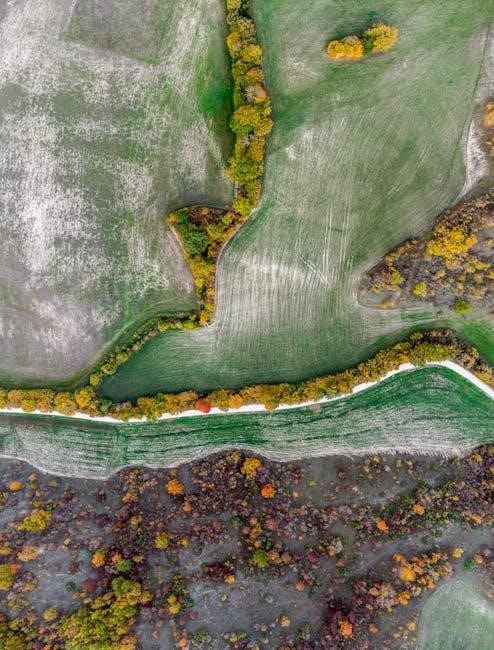
The Ecological Landscape of New England Before Colonization
Cronon’s work, available as a PDF, details a pre-colonial New England actively shaped by Native Americans through practices like controlled burns and agriculture.
Native American Land Management Practices
Cronon’s Changes in the Land, accessible as a PDF, reveals that pre-colonial New England wasn’t a pristine wilderness, but a culturally constructed landscape. Indigenous populations actively managed the environment, employing techniques far removed from European notions of “untouched” nature.
These practices included deliberately setting fires to promote specific plant growth, creating meadows for game, and fostering forest compositions beneficial for hunting and gathering. Native Americans understood and manipulated ecological processes, shaping the land to enhance resource availability and support their way of life. This wasn’t simply subsistence; it was a sophisticated system of ecological knowledge and intervention.
The book emphasizes that these weren’t random acts, but carefully considered strategies passed down through generations, demonstrating a deep understanding of the New England ecosystem.
Impact of Indigenous Practices on Forest Composition
As detailed in Cronon’s Changes in the Land – available as a PDF for study – Indigenous land management significantly influenced New England’s forest composition. Regular, controlled burns favored the growth of chestnut, oak, and pine, creating open woodlands rather than dense, closed-canopy forests.
These practices increased the abundance of species valuable for food, tools, and shelter. The intentional shaping of the landscape resulted in a mosaic of habitats, supporting diverse plant and animal communities. Cronon argues this wasn’t a ‘natural’ state, but a product of centuries of human intervention.
This contrasts sharply with the European expectation of a wild, untamed forest, highlighting differing cultural perceptions of nature.
Role of Fire in Shaping the New England Ecosystem
William Cronon’s Changes in the Land, accessible as a PDF, emphasizes the crucial role of fire in maintaining the pre-colonial New England ecosystem. Indigenous populations actively used fire as a land management tool, intentionally burning underbrush and forests to promote specific plant growth.
These controlled burns reduced the risk of larger, more destructive wildfires, while encouraging the regeneration of species like chestnut and oak. This created open woodlands favored for hunting and gathering. Cronon demonstrates that the landscape Europeans encountered wasn’t pristine wilderness, but a culturally shaped environment.
The suppression of these fires by colonists dramatically altered forest composition.
Traditional Native American Agriculture
William Cronon’s Changes in the Land, available as a PDF, details how Native American agricultural practices differed significantly from European methods. Indigenous communities employed a sophisticated understanding of local ecosystems, utilizing techniques like the “three sisters” – corn, beans, and squash – for synergistic growth.
These methods minimized soil depletion and maximized yields, demonstrating a sustainable approach to food production. Cronon highlights the importance of swidden agriculture, or “slash-and-burn,” not as destructive, but as part of a rotational system that allowed for forest regeneration.
This contrasted sharply with the European emphasis on permanent fields and livestock.

The Arrival of European Colonists and Ecological Shifts
Cronon’s Changes in the Land (PDF accessible online) reveals how European arrival instigated dramatic ecological changes in New England, altering land use profoundly.
William Cronon’s Changes in the Land, available as a PDF for detailed study, highlights the significant shift in agricultural practices following European colonization. Colonists introduced techniques vastly different from those employed by Native Americans, prioritizing individual land ownership and intensive cultivation.
These new methods, detailed within the book, included plowing, the planting of European crops like wheat, and a focus on field agriculture. This contrasted sharply with Indigenous practices of swidden agriculture and forest gardening. The introduction of livestock, also discussed in the PDF version, further transformed the landscape, impacting forest composition and soil health, as Cronon meticulously documents.
These changes, as explored in Changes in the Land, weren’t simply agricultural; they represented a fundamental alteration in the relationship between humans and the environment.
Changes in Land Ownership and Use
William Cronon’s Changes in the Land, accessible as a PDF, meticulously details the radical transformation of land ownership in New England following European arrival. Indigenous concepts of communal land use and stewardship were replaced by a European system of private property, fundamentally altering the relationship between people and the environment.
The book, readily available online, explains how colonists asserted ownership through deeds and fences, dividing the landscape into individually held parcels. This shift, as Cronon illustrates, led to intensified exploitation of resources and a focus on maximizing individual profit. The PDF version reveals how this new system fueled deforestation and altered traditional patterns of resource management.
These changes, as documented in Changes in the Land, were central to the ecological shifts Cronon analyzes.
Impact of Livestock Grazing on the Environment
William Cronon’s Changes in the Land, obtainable as a PDF, highlights the significant ecological impact of European livestock grazing in New England. Colonists introduced large numbers of cattle, sheep, and pigs, which dramatically altered the landscape, unlike the more measured impact of Indigenous practices.
The PDF version details how uncontrolled grazing led to widespread deforestation as animals consumed saplings and prevented forest regeneration. This, in turn, contributed to soil erosion and altered water runoff patterns. Cronon demonstrates how the introduction of livestock fundamentally reshaped the composition of New England’s forests and grasslands.
The book emphasizes that this wasn’t simply a matter of animal numbers, but a shift in land-use philosophy.
Deforestation and its Consequences
William Cronon’s Changes in the Land, accessible as a PDF, meticulously documents the extensive deforestation that occurred in New England following European colonization. The demand for timber – for shipbuilding, housing, and fuel – fueled widespread logging operations, radically altering the region’s forests.
The PDF reveals how this deforestation had cascading ecological consequences. Soil erosion increased dramatically, impacting water quality and agricultural productivity. Changes in forest cover also affected local climate patterns and wildlife habitats. Cronon argues that deforestation wasn’t merely a resource extraction process, but a fundamental reshaping of the New England ecosystem.
He details how this transformation was driven by a market economy.

The Rise of a Market Economy and its Ecological Effects
Cronon’s Changes in the Land PDF details how the shift to a market economy—driven by the fur trade and logging—profoundly altered New England’s ecology.
Commercial interests prioritized profit over sustainable practices.
The Fur Trade and its Impact on Animal Populations
William Cronon’s Changes in the Land, accessible as a PDF, meticulously documents the devastating ecological consequences of the burgeoning fur trade in colonial New England.
Initially driven by beaver pelts, the demand for animal skins rapidly expanded to include deer, bear, and other species. This insatiable European appetite triggered widespread hunting, exceeding sustainable levels.
Cronon illustrates how Indigenous hunting practices, traditionally focused on sustenance and balance, were disrupted by the colonists’ commercial motivations. The introduction of firearms further exacerbated the decline of animal populations, fundamentally reshaping the New England ecosystem. The pursuit of profit, as detailed in the PDF, overshadowed ecological considerations.
Commercial Logging and Timber Exports
William Cronon’s Changes in the Land, available as a PDF, reveals how commercial logging dramatically altered New England’s forests. Driven by export demands – particularly to England – timber became a crucial commodity.
Initially focused on white pine for shipbuilding masts, logging operations expanded to encompass a wider range of tree species. This large-scale removal of timber had profound ecological consequences, contributing significantly to deforestation.
Cronon details how the shift from small-scale woodcutting for local needs to large-scale timber exports fundamentally changed the relationship between colonists and the forest, prioritizing economic gain over ecological sustainability, as evidenced in the PDF.
Development of Mills and Water Power
William Cronon’s Changes in the Land, accessible as a PDF, highlights the pivotal role of mills and water power in transforming the New England landscape; Colonists rapidly adopted water-powered mills for sawing lumber, grinding grain, and processing other goods.
The construction of dams and millponds dramatically altered waterways, impacting river ecosystems and fish populations. This development fueled economic growth but also represented a significant intervention in the natural environment.
Cronon demonstrates, within the PDF, how the harnessing of water power wasn’t merely a technological advancement, but a cultural practice reshaping the land and its resources for commercial purposes.
Shifting Agricultural Focus: From Subsistence to Market
William Cronon’s Changes in the Land, available as a PDF, details the crucial transition in New England agriculture from self-sufficiency to market-oriented production. Initially, colonists focused on growing food for their families, mirroring some Indigenous practices.
However, as connections to wider markets developed, farmers increasingly cultivated crops and raised livestock for sale, driven by profit. This shift demanded larger landholdings and altered farming techniques.
The PDF reveals how this economic transformation profoundly impacted the landscape, leading to deforestation, soil depletion, and a changing relationship between humans and the land.

The Transformation of New England’s Ecosystem
Cronon’s Changes in the Land PDF illustrates how colonization dramatically altered New England’s forests, soils, and waterways, creating “second-growth” forests and impacting native species.
Changes in Forest Composition (Second Growth Forests)
William Cronon’s Changes in the Land, accessible as a PDF, details how colonial land use led to the disappearance of the original forests of New England. These weren’t simply cleared, but fundamentally altered;
The initial old-growth forests, shaped by Indigenous practices and natural processes, were replaced by “second-growth” forests – ecosystems dominated by different tree species. Colonists favored certain trees for timber and agriculture, impacting forest composition.
This shift, thoroughly documented in the PDF version, wasn’t a natural succession but a direct consequence of European agricultural techniques, logging, and grazing. The book highlights how this transformation fundamentally reshaped the New England landscape.
Impact on Native Plant and Animal Species
William Cronon’s Changes in the Land, available as a PDF, meticulously details the devastating impact of colonization on New England’s native flora and fauna. The ecological shifts weren’t merely about forest changes; they triggered a cascade of consequences for countless species.
Indigenous land management sustained biodiversity, but European practices disrupted these delicate balances. Habitat loss, overhunting (particularly related to the fur trade, as discussed in the PDF), and the introduction of livestock dramatically altered species distribution.
Cronon illustrates how certain native plants and animals declined or disappeared entirely, while others struggled to adapt to the rapidly changing environment, reshaping the ecosystem.
Soil Erosion and Degradation
William Cronon’s Changes in the Land, accessible as a PDF, highlights how European agricultural techniques led to significant soil erosion and degradation in New England. Unlike Indigenous practices that maintained soil health, colonial farming methods often prioritized short-term yields over long-term sustainability.
Deforestation, a central theme within the PDF, removed vital tree cover, leaving the soil vulnerable to wind and water erosion. Intensive livestock grazing further compacted the soil, reducing its ability to absorb water and increasing runoff.
This degradation diminished agricultural productivity and altered the landscape, impacting waterways and contributing to broader ecological changes.
Alterations to Waterways and Wetlands
William Cronon’s Changes in the Land, available as a PDF, details how colonial practices dramatically altered New England’s waterways and wetlands. Deforestation, a key focus within the text, increased sedimentation in rivers and streams, impacting aquatic ecosystems.
The construction of mills and dams, discussed in the PDF, further disrupted natural water flows and fish migration patterns. Wetlands were drained for agriculture and settlement, reducing biodiversity and diminishing their crucial role in flood control.
These alterations fundamentally reshaped the hydrological landscape, demonstrating the profound impact of human activity on the region’s water resources.
“Changes in the Land” — Key Themes and Arguments
Cronon’s Changes in the Land, accessible as a PDF, argues that the New England landscape is a “second nature”—a cultural product shaped by human interaction.
The Concept of “Second Nature”

Cronon’s central argument revolves around the idea of “second nature,” challenging the conventional understanding of wilderness as a purely pristine, untouched realm. He posits that the New England landscape, even before European arrival, was already a “cultural product,” actively shaped by centuries of Indigenous land management practices.
This concept, explored extensively in the readily available PDF version of Changes in the Land, suggests that nature isn’t simply “out there,” but is instead a constantly evolving interplay between ecological processes and human agency. The colonists didn’t discover a wilderness; they encountered a landscape already molded by Native American interventions, and then imposed their own transformative changes upon it.
Understanding “second nature” is crucial for deconstructing the romanticized “wilderness myth” and recognizing the deep historical roots of the present-day environment.
The Role of Culture in Shaping the Landscape
Cronon, in Changes in the Land – accessible as a PDF – powerfully demonstrates that the New England landscape is fundamentally a cultural artifact. He argues against the notion of a purely “natural” environment, revealing how both Native American and European cultures actively constructed and modified the ecosystem.
Indigenous practices, like controlled burns, intentionally shaped forest composition and promoted biodiversity. Subsequently, colonial agricultural techniques, livestock grazing, and commercial logging dramatically altered the land, driven by economic motives and European cultural norms.
The book highlights how cultural values, economic systems, and technological innovations are inextricably linked to ecological change, proving that the landscape is not simply in culture, but of culture.
Critique of the Wilderness Myth
Cronon’s Changes in the Land, widely available as a PDF, directly challenges the romanticized “wilderness myth” prevalent in American thought. He argues that the idea of a pristine, untouched New England before European arrival is historically inaccurate and obscures the active role of Native Americans in shaping the environment.
Indigenous populations actively managed the land through practices like controlled burns and agriculture, creating a landscape far from “wild” in the traditional sense; The book demonstrates that the concept of wilderness is itself a cultural construct, born from specific historical and social contexts.
By deconstructing this myth, Cronon reveals a more complex and nuanced understanding of the relationship between humans and the natural world.
The Interplay Between Humans and the Environment
William Cronon’s Changes in the Land, accessible as a PDF, fundamentally explores the dynamic relationship between human actions and ecological consequences in colonial New England. The book meticulously details how both Native American and European practices profoundly altered the landscape.
Cronon demonstrates that the environment wasn’t a passive backdrop but actively shaped, and was shaped by, human cultures and economies. He highlights how shifts in land ownership, agricultural techniques, and market forces triggered cascading ecological effects.
This interplay, he argues, reveals that “nature” and “culture” are not separate entities, but inextricably linked and mutually constitutive.
Reception and Impact of the Book
Cronon’s Changes in the Land, widely available as a PDF, garnered significant academic acclaim and profoundly influenced environmental history scholarship.
Its impact extends to contemporary environmental issues, prompting reevaluation of human-nature interactions.
Academic Reviews and Scholarly Influence
William Cronon’s Changes in the Land, often accessed as a PDF, received overwhelmingly positive reviews upon its 1983 publication and subsequent revisions. Scholars lauded its innovative approach, blending ecological history with colonial studies.
The book quickly became a cornerstone text in environmental history, influencing a generation of researchers to consider the active role of culture in shaping landscapes. It challenged traditional narratives of pristine wilderness, demonstrating how Native American practices actively managed the New England ecosystem.
Its influence extends beyond history, impacting fields like anthropology, geography, and environmental studies, prompting interdisciplinary research and a more nuanced understanding of human-environment relationships.
Influence on Environmental History
William Cronon’s Changes in the Land, widely available as a PDF, fundamentally reshaped the field of environmental history. It moved the discipline beyond simply documenting environmental degradation, instead focusing on the dynamic interactions between humans and their surroundings.
The book’s emphasis on ecological transformation, driven by cultural practices, established a new paradigm for understanding the American landscape. It demonstrated that “wilderness” was not a pre-existing condition, but a cultural construct shaped by both Indigenous and colonial actions.
Cronon’s work inspired countless scholars to investigate the ecological consequences of historical events, fostering a more holistic and interdisciplinary approach to environmental study.
Relevance to Contemporary Environmental Issues
William Cronon’s Changes in the Land, accessible as a PDF, remains strikingly relevant to today’s environmental challenges. The book’s exploration of long-term ecological consequences highlights the enduring impact of past actions on present-day ecosystems.
Its critique of the “wilderness myth” challenges simplistic notions of conservation, urging a more nuanced understanding of human intervention in nature. The book’s focus on the interplay between culture and environment informs contemporary debates about land use, resource management, and climate change.
Understanding historical ecological shifts, as Cronon details, is crucial for developing sustainable solutions for the future.
Availability of the PDF Version and its Usage
The PDF version of William Cronon’s Changes in the Land is widely accessible online through platforms like DOKUMEN.PUB and Course Hero, facilitating academic study. Students and researchers frequently utilize the digital format for convenient access and annotation.
Amazon also offers the eBook version, providing another avenue for digital readership. The PDF’s portability allows for easy integration into research projects and coursework. Its usage extends beyond formal education, informing environmental discussions and historical analyses.
The readily available PDF ensures Cronon’s work continues to reach a broad audience.
Further Exploration of Cronon’s Work
William Cronon’s scholarship extends beyond Changes in the Land; exploring his related publications deepens understanding. The accessible PDF aids comprehensive research.
Related Publications by William Cronon
William Cronon has authored several impactful works complementing Changes in the Land, offering broader perspectives on American environmental history. Nature’s Metropolis: Chicago and the Great West (1991) examines the ecological and economic connections between Chicago and its hinterland.
The Trouble with Wilderness: Or, Getting Back to the Wrong Nature (1995) critically analyzes the American concept of wilderness. His essays, collected in volumes like Uncommon Ground: Rethinking the Human Place in Nature (1995), further explore themes of landscape and culture.
Accessing the PDF of Changes in the Land provides a foundational understanding for appreciating the depth and breadth of Cronon’s scholarship, revealing consistent themes across his diverse body of work.
Connections to Other Works in Environmental History
William Cronon’s Changes in the Land resonates with other pivotal works in environmental history, like Alfred Crosby’s The Columbian Exchange, which details the biological consequences of transatlantic contact. Roderick Nash’s Wilderness and the American Mind complements Cronon’s critique of the wilderness myth.
Donald Worster’s Nature’s Economy provides a broader framework for understanding the historical relationship between humans and the environment. Studying the PDF of Cronon’s book alongside these texts reveals shared concerns about ecological transformation and cultural perceptions.
These works collectively demonstrate a shift towards interdisciplinary approaches in understanding the past.
Resources for Studying New England Ecology
Beyond William Cronon’s insightful PDF, numerous resources aid in studying New England’s ecology. The New England Historical Society offers articles detailing the region’s environmental past. University websites, like Harvard Forest, provide research data and publications on forest dynamics.
The US Forest Service and state environmental agencies offer reports on current ecological conditions. Local historical societies often possess archival materials documenting land use changes. Online databases, such as JSTOR, provide access to scholarly articles.
These resources, combined with Cronon’s work, offer a comprehensive understanding of New England’s ecological history.
Where to Find the “Changes in the Land” PDF
Locating a PDF version of William Cronon’s “Changes in the Land” requires careful navigation. DOKUMEN.PUB is a frequently cited source, offering the text for download. Course Hero also hosts excerpts, though full access may require a subscription.
Amazon provides the eBook version, accessible on Kindle devices, which can be converted to a PDF. University libraries often offer digital access to students and faculty. Be cautious of unofficial sources, ensuring they are legitimate and virus-free.
Always verify the source’s credibility before downloading any PDF file.